LLMaaO (LLM as an Oracle)
More to pedagogy than nice visuals. AI usage needn’t be all-or-nothing. Close open loops. Free thyself.
I’ve lately been having fun using LLMs as teaching assistants in a different way
from the usual “generate me a nice HTML explaining X” seen in /teach and other
skills.
This all started when I took a stab at the “Original Performance Take Home” that Anthropic published, a take-home challenge that was previously used in their hiring process for performance engineers.1
Having committed to not using any AI assistance at all, I spent quite a few hours getting the solution down to 4,974 cycles (still not as good as Opus 4.5, which managed to reach 1,363 cycles). This was very stimulating and a lot of fun, even though it revealed just how bad and slow I am. I would’ve blasted through the challenge with AI assistance restricted to only the coding parts, not the high-level optimization ideas, but I use LLMs too much at work and needed a change of scenery.
At some point I got stuck and, while I had quite a few ideas, I wasn’t sure which direction was the most promising. I had reached the point where even evaluating the feasibility of an idea required effort.
Having stagnated, with the novelty having worn off and not much motivation to beat the challenge, I got concerned that I’d just end up quitting and missing out on some learning opportunities. At the same time, I did not want to just look at a solution, say “ah, obviously,” and pretend I learned anything.
So, I decided to rely on AI assistance of a very restricted kind. I wanted two things:
- to avoid going down dead ends
- to accelerate (but not entirely delegate) writing the code
(Granted, the second point does not reflect the title of this post, but I needed something catchy.)
If you think of problem-solving as navigating a large space of possible approaches, where only a few paths lead to the solution, it’s very easy to go down a dead end: there are many more dead ends than correct paths. Moreover, it’s not just the size of the search space that makes a problem hard (and interesting) in the first place, but the difficulty of being able to tell which path is feasible.
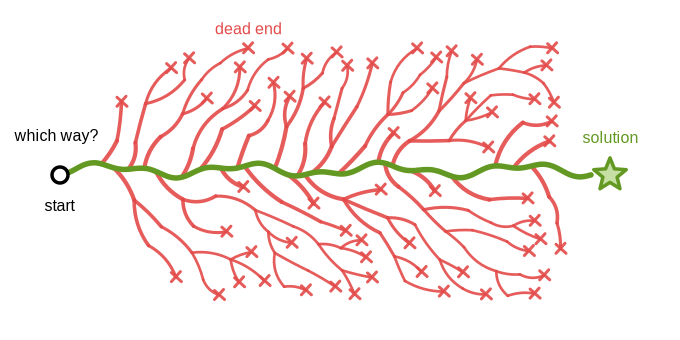
Thus, having access to an oracle, an entity that can answer with a simple yes or no to the question of the feasibility of a direction, would drastically reduce the time needed to find the right solution. (The term oracle was borrowed from complexity theory; see for example Section 9.2 in Sipser [1].)
The other difficulty, of course, is having ideas in the first place!2 And so I decided that, having a few ideas but not the time to try them all out, I could still experience much of the intended learning effect by using an LLM as an oracle.
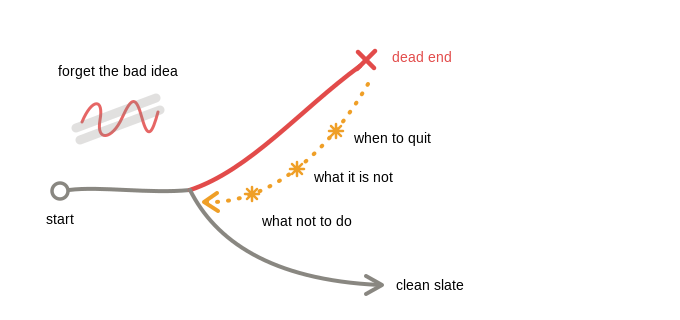
Naturally, some of that learning would be lost. Wrong turns teach you things too: what not to do, what something is not, when to quit, how to start anew without letting the failed attempt linger in your head. (Unlearning is hard.)
I accepted this trade-off.
Reducing the exploration time was one dimension; translating the ideas into code was also a bit hairy as generating the assembly was not nicely abstracted in the code, but was rather just raw string generation. All useful abstractions needed to be built. So I decided to let LLMs help me out there too. I was now operating almost entirely at the level of ideas.
I decided to trust myself to use the LLM in this restricted way, still not letting it generate ideas or explain finer details. It went delightfully well!
I got down to 2,000 cycles and still felt like I’d learned a lot.
For example, at some point I realized that the next big improvement would likely be automating the packing of instructions into bundles. Up to that point, I had done that locally within one loop iteration and gotten quite close to the limit. So, although I had a strong suspicion that doing this globally would be quite productive, I had the oracle confirm that for me.
Once confirmed, I was able to use the LLM as a Socratic dialogue partner to flesh it out, again without becoming overly reliant. At this point it would’ve been trivial to just say “hey, now just implement instruction packing,” feeling proud that “I had gotten the idea right.” But I wanted more.
I was doing much of this work on my phone, without access to pen and paper (or some other “scratch space”), so using the LLM as a conversational partner was quite helpful. I started off by saying:
ok, now let me think about what’s necessary to make a better scheduler. i think the number one thing is data dependencies. so we should be able to, when emitting, also list a dependency.
now i wonder what the right way to do this is
one thing i was thinking is for emit to return an id (could be arr idx, could be something else), and then that can be used as an arg in the emit of the instruction that depends on this.
what do you think? discuss
The LLM was eager to give me way too much hand-holding here, so I had to prompt it to
be socratic with me and don’t reveal the answer immediately
That worked decently well. (I had to repeatedly tell it to tell me less and less, as it often liked to give me the benefit of the doubt and fill the gaps for me.)
It walked me through the different steps to determine how to build the dependency relationships. Granted, it was a bit too helpful, as I certainly would’ve made some wrong decisions here, but that’s no different from any teacher.
Naturally, this method is easier than deriving the rules alone, and I realized as much. I told the LLM:
Hmm this is really clean and nice. I’m worried I wouldn’t have come up with this. I am worried that my approach would’ve been very different, that I wouldn’t have explored the cases so cleanly and thoroughly, that I would’ve written some of the “easy” dependencies and used the actual instructions to try to derive the rules, instead of thinking abstractly and from first principles.
I want to be honest and not delude myself. Yes, this was not nearly as fruitful as a solo effort would have been. Even so, the entire endeavor was ultimately productive. I managed to get unblocked and make progress, freeing up time to work on other things instead of adding yet another project to the graveyard. At the same time, it’s clear to me this is qualitatively different from a purely vibe-coded project. The gap is not small at all. I feel confident that I learned quite a lot.
My takeaway is that I get the best out of LLMs when I start without them at all, and this is something I want to carry over to my work as well.
References
[1] M. Sipser, Introduction to the Theory of Computation. Cengage Learning, 2012.
Tristan Hume wrote a nice article back in January 2026 on why Anthropic stopped using this challenge and what makes a good technical evaluation. I presume this looks vastly different today, just 10 months later. ↩︎
In complexity theory this isn’t considered difficult because ideas can just be naively enumerated, and the massive cost is exploring the search space! So an oracle suffices, as long as it can tell you whether a solution lies down a given branch. ↩︎